It’s true. Yep.
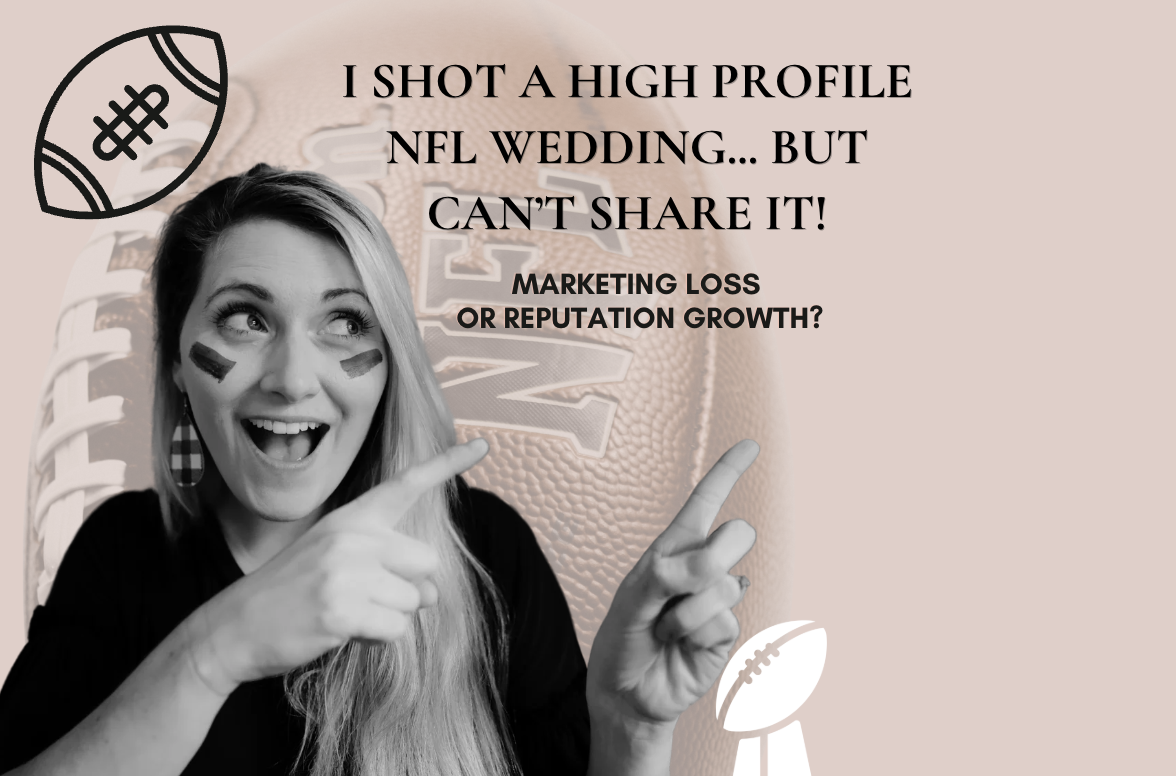
A high-profile NFL wedding.
Beautiful wedding. Incredible people. The kind of wedding that, from a marketing perspective, photographers would LOVE to be able to share about.
And I can’t show you the photos.
I can’t blog the wedding.
I can’t make a Reel saying, “Come photograph an NFL wedding with me.”
I can’t tag the couple.
I can’t use the images to attract similar clients.
I can’t capitalize on the name recognition.
And as a photographer and business owner?
There is absolutely a marketing loss in that.
But there’s also something potentially much more valuable happening behind the scenes:
Reputation Building.
And if you want to photograph high-profile clients, celebrities, professional athletes, executives, politicians, or simply very private people, you need to understand the difference.
The Wedding You Want to Share the Most Might Be the One You Shouldn’t
Wedding photographers are trained to think about portfolio value.
We photograph a beautiful wedding and immediately see all the possibilities:
Website.
Instagram.
Pinterest.
Blog.
Venue tags.
Vendor collaborations.
Reels.
Publications.
SEO.
Ads.
Portfolio refresh.
A single incredible wedding can give you MONTHS of marketing content.
So when a client says their wedding needs to remain private, there is a legitimate business cost associated with that.
I’m not going to pretend there isn’t.
There are photographs sitting on my hard drives that would be fantastic for our portfolio. There are weddings that could potentially open doors simply because of who was there or what the wedding looked like.
And I can’t use them. That stings a little when you’re running a business where your work is quite literally your marketing.
But here’s what I’ve learned:
Not everything valuable in your business is visible on Instagram.
Sometimes You’re Building a Portfolio. Sometimes You’re Building a Reputation.
Those are not always the same thing.
A portfolio says:
Look what I can photograph.
A reputation says:
Look at who trusts me.
And the second one can become incredibly powerful.
High-profile clients often live in circles with other high-profile people. Their friends may be professional athletes. Their wedding party may include public figures. Their planners may regularly work with clients who require privacy.
And those people talk.
They notice how vendors behave.
Were you professional?
Were you discreet?
Did you make the day feel normal?
Were you photographing the wedding or acting starstruck?
Did you post something you shouldn’t have?
Did you respect the boundaries that were established?
Could you be trusted?
Because at a certain level, discretion becomes part of the service you’re providing.
The Fast Marketing Win vs. The Long Reputation Win
This is where photographers have to think beyond the dopamine hit of posting.
Imagine photographing a recognizable person and immediately posting:
“OMG LOOK WHO I GOT TO PHOTOGRAPH!!!”
Maybe that post performs incredibly well.
Maybe you get thousands of views.
Maybe photographers start sharing it.
Maybe your following grows.
That’s the short-term marketing win.
But if the client expected privacy?
You may have just traded trust for engagement.
And engagement disappears.
Reputation travels.
Especially within industries and social circles where privacy matters.
I’d much rather have a planner tell another high-profile client,
“You can trust Maggie and Patrick. They photographed another client of ours and were incredibly discreet.”
That referral will never show up in my Instagram analytics.
But it may be worth significantly more to my business.
And Yes — You Can Still Be Frustrated About the Marketing Loss
I think we need to say this part because business education sometimes gets unnecessarily fluffy.
You can completely respect your client’s privacy AND think:
Dang. I wish I could share this wedding. 😂
Both can be true. There are real opportunity costs.
You lose potential SEO traffic.
You lose social content.
You lose vendor tagging opportunities.
You lose portfolio images.
You lose the ability to publicly associate your company with a recognizable client.
And depending on the wedding, that could represent a substantial amount of marketing value.
That’s why photographers need to understand usage rights, model releases, contracts, NDAs, privacy expectations, and client communication BEFORE assuming that photographing something automatically means you should publish it.
But once you’ve agreed to privacy?
Your reputation is worth more than the post. Every time.
Don’t Try to Sneak Around It Either
This deserves its own section.
Don’t post the flowers because “technically nobody is in the picture.”
Don’t post a vague Story from the venue.
Don’t photograph the invitation suite and conveniently leave the names barely visible.
Don’t post something saying:
“Can’t tell you who I’m photographing today 👀🏈”
That is not discretion.
If someone has asked for privacy, give them privacy.
Your job isn’t to figure out how close you can get to the boundary without technically crossing it.
Your job is to become the photographer that people feel completely comfortable inviting into private spaces.
Because wedding photographers see EVERYTHING.
We see family dynamics.
We hear conversations.
We’re inside hotel rooms.
We’re around personal belongings.
We’re present for emotional moments.
We may know locations, schedules, names, phone numbers, family members and information that isn’t public.
Trust has always been part of this job.
High-profile weddings simply make that responsibility more obvious.
So How DO You Market a Wedding You Can’t Share?
You market the experience and expertise you gained without exploiting the client.
Maybe you learned something about working with security.
Maybe you learned how to handle guests who don’t want photographs published.
Maybe you learned how to communicate with planners managing a high-profile event.
Maybe there were logistical considerations you’ve never encountered before.
Maybe you simply became better at being calm, professional and unobtrusive in an environment where discretion mattered.
Teach from the experience without revealing the experience.
Which, ironically, is exactly what I’m doing right now.
I don’t need to tell you who the client was.
I don’t need to show you their photographs.
I don’t need to give you clues so you can figure it out.
The educational value exists without exposing the person who trusted us.
Your Best Marketing Asset Might Be Something Nobody Can See
Photographers spend a LOT of time worrying about what our feeds look like.
But after years in this industry, I’m increasingly convinced that some of the most valuable things we’ve built aren’t visible online.
They’re conversations between planners.
They’re referrals between brides.
They’re vendors saying, “You should hire them.”
They’re families inviting us back.
They’re clients trusting us with increasingly important moments.
They’re people knowing that what happens around us doesn’t automatically become content.
That doesn’t mean marketing doesn’t matter.
It absolutely does.
I still want the beautiful portfolio.
I still want the blog traffic.
I still want the Reel.
Trust me — I REALLY want the Reel. 😂
But there are moments when protecting a client’s privacy is actually building something bigger than content.
You’re building the kind of reputation that gets you invited into rooms you can’t post about.
And that’s a pretty incredible place for a business to be.
THE TAKEAWAY FOR PHOTOGRAPHERS
Your portfolio can get you noticed.
Your marketing can get you inquiries.
Your social media can get you reach.
But your reputation gets you trust.
So photograph the incredible weddings.
Create the beautiful work.
Market the weddings you’re allowed to market the heck out of.
But when someone trusts you with something that isn’t yours to share?
Protect it.
Because sometimes the wedding you can never put in your portfolio becomes one of the most valuable weddings you’ve ever photographed.



+ COMMENTS
add a comment